The end of anonymous Bitcoin ATMs and the final stand for financial privacy
Why mandatory id checks are forcing a mass migration to self custody
2 March 2026 • 4 min read
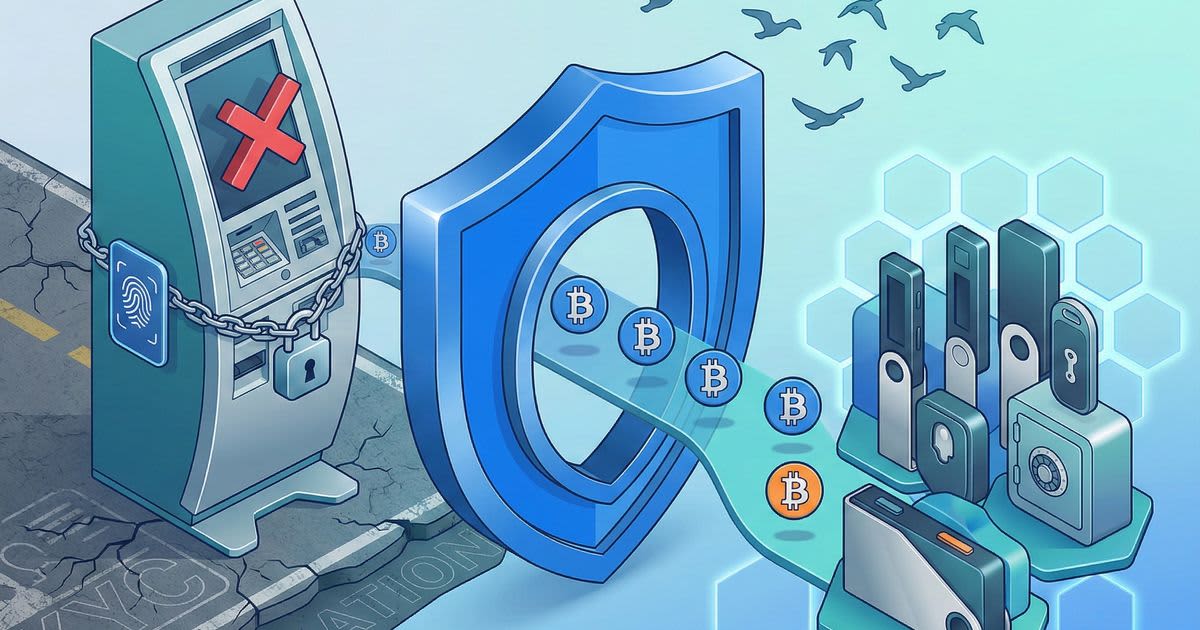
The era of walking up to a street-side kiosk and swapping cash for Bitcoin without handing over your life story is officially over. As of February 2026, new mandates have forced the world's largest Bitcoin ATM networks to implement strict, mandatory ID checks for every single transaction. What was once a convenient exit from the traditional financial system has now become just another node in the global surveillance net.
This change marks a significant turning point for anyone who values financial sovereignty. For years, these machines served as a bridge for those who wanted to stack sats without the friction of centralized exchanges. Now, that bridge has a toll booth that requires a digital ID, a face scan, and a direct link to your personal identity.
The closing of the surveillance loop
This isn't an isolated event. It is part of a broader trend where regulators are tightening the screws on how individuals interact with digital assets. We are seeing a similar pattern with e-rupee vs. self-custody and maintaining privacy under India's new 2026 banking rules, where the push for central bank digital currencies (CBDCs) is making private transactions nearly impossible within the legacy banking system.
When you use a Bitcoin ATM that requires an ID, you aren't just buying Bitcoin. You are creating a permanent, public record on the blockchain that links your physical identity to a specific wallet address. In a world where data leaks are common, this is a massive security risk. We saw the fallout of centralized vulnerabilities during what the axiom insider trading scandal reveals about the dangers of exchange privacy, and the same logic applies here. If the ATM provider is breached, your identity and your Bitcoin balance are exposed to whoever wants that data.
Why self custody is the only exit remaining
As the walls close in on "easy" privacy, the community is moving toward a more robust solution: self-custody. Users are realizing that if they can't buy privately, they must at least hold privately. Maintaining an unlinked, non-custodial wallet is no longer a niche hobby for tech enthusiasts. It is a fundamental requirement for anyone who wants to keep their wealth away from prying eyes and "agentic bots" that scan the web for easy targets.
To stay ahead of these risks, many are turning to devices like the Trezor Safe 5, which offers an open-source security model that doesn't rely on a third party's permission. By moving assets to a hardware wallet, you break the tether to the exchange or the ATM provider's database.
The hardware defense strategy
The shift we are seeing in 2026 is driven by more than just local regulations. Recent events, including how recent global geopolitical shocks are driving the largest self-custody wave of 2026, have proven that you cannot trust a middleman to protect your interests during times of crisis.
If you are serious about protecting your privacy in this new regulatory landscape, your setup needs to be airtight. This includes:
- Non-custodial hardware: Using a device like the Keystone 3 Pro ensures you have physical control over your biometric data and your private keys.
- Physical backups: Digital surveillance can't track a piece of stainless steel. Protecting your recovery words with an Etherbit Plate X ensures that even if your hardware is lost, your wealth isn't.
- Multi-factor security: Using a Yubico YubiKey 5C NFC to secure your email and exchange accounts can prevent the kind of identity theft that often follows a KYC data breach.
Preparing for the future of financial sovereignty
The death of the anonymous Bitcoin ATM is a loud signal that the "wild west" days of crypto are being paved over by government infrastructure. While the 2026 Indian tax survival guide for hodlers provides a roadmap for staying compliant, it is equally important to maintain a private reserve that isn't dependent on the uptime or the whims of a service provider.
Bitcoin was designed to be peer-to-peer electronic cash. When the "peer" on the other side is a regulated corporation demanding your ID, the original mission of the protocol rests entirely on your shoulders. Self-custody is the final stand for financial privacy. It is the only way to ensure that your money remains yours, regardless of how many kiosks are forced to scan your ID.
Related posts

The great Q1 wealth transfer and why paper Bitcoin is failing the modern Indian investor
3 March 2026 • 5 min read

How a Pentagon cybersecurity panic triggered the crypto rotation into tokenized gold
20 May 2026 • 3 min read
Unexpected central bank rate hikes are accelerating institutional flight to blockchain settlement
17 September 2026 • 3 min read


Industrial metal tariffs and geopolitical friction are forcing a digital asset rotation
6 April 2026 • 3 min read

The great asset rotation from gold to yield as Washington deregulates digital markets
23 March 2026 • 3 min read