Why cloud synced passkeys are a disaster for your Bitcoin security
Convenience always comes with a hidden cost for self custody.
2 March 2026 • 5 min read
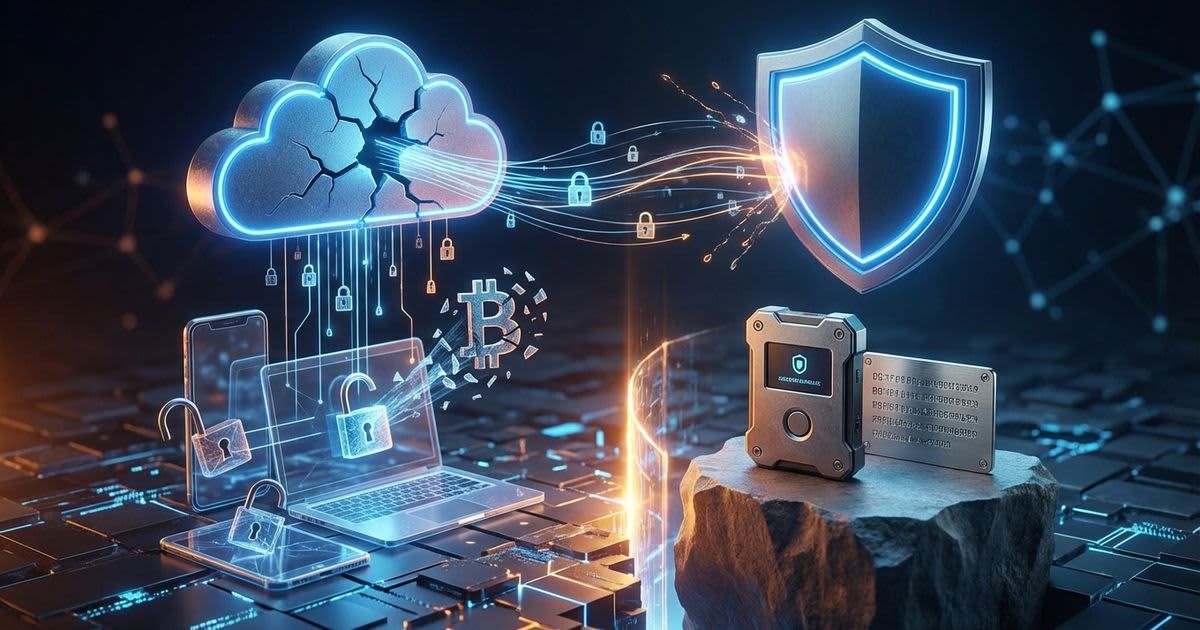
Apple and Google have spent the last few years aggressively pushing a passwordless future. They want you to replace your complex passwords with passkeys authenticated by your face or fingerprint. For your daily coffee shop app or streaming service account, this is a massive leap forward in usability. But as software wallets start adopting this consumer-grade technology in 2026, a dangerous narrative is taking hold. Tech giants are convincing users that tying their cryptocurrency to a cloud account is both safe and sufficient.
It is not. Storing the keys to your financial independence on a server managed by a third party completely breaks the fundamental rule of self custody. Convenience always comes with a hidden cost, and when it comes to securing your digital wealth as the 20 millionth Bitcoin is mined, that cost could be your entire net worth.
The fatal flaw in cloud synchronization
A passkey relies on public-key cryptography. Your device generates a unique pair of cryptographic keys. The public key is shared with the app or website, while the private key stays on your device. In a vacuum, this is highly secure. The flaw emerges when tech ecosystems prioritize user experience over absolute security.
If you lose your phone, Apple and Google do not want you to lose access to your accounts. To solve this, they automatically sync your passkeys across all your devices using iCloud Keychain or Google Password Manager. This means your private key is no longer strictly bound to the physical hardware in your hand. It is copied, encrypted, and uploaded to their servers.
When a software wallet lets you secure your funds with a synced passkey, it essentially turns your Google or Apple account into your seed phrase. If a malicious actor gains access to your cloud account through session hijacking, a targeted phishing campaign, or an MFA fatigue attack, they can sync your passkeys to their own device. From there, draining your wallet takes seconds. We have already seen the severe consequences of trusting central entities with our financial data. A quick look at what the Axiom insider trading scandal reveals about the dangers of exchange privacy shows that outsourcing security to centralized players always shifts the attack vector to a single point of failure.
True self custody requires physical isolation
Consumer tech is designed to be recoverable. Bitcoin is designed to be immutable. These two philosophies are entirely incompatible. When you hold a meaningful amount of cryptocurrency, your security model must assume that your phone, your laptop, and your cloud accounts are already compromised.
This is why traditional seed phrases and true air-gapped hardware remain the gold standard. A device like the SafePal S1 or the Keystone 3 Pro never connects to the internet. They do not have Bluetooth, WiFi, or cloud sync capabilities. Your private keys are generated offline and stay offline. You authorize transactions via a QR code or an isolated USB connection, ensuring that even if your computer is infected with malware, your keys cannot be extracted.
For Indian crypto holders navigating a complex regulatory environment, reliance on multinational tech companies introduces unnecessary jurisdictional risk. Apple and Google comply with local data requests. Your hardware wallet does not. You can review the new EU DACA rules and why Indian crypto holders need to review their self custody setup to understand how quickly digital privacy regulations can shift and impact cloud-based assets.
Securing the foundation of your wealth
Abandoning cloud-synced passkeys for your cryptocurrency does not mean you have to live in the dark ages of cybersecurity. It just means applying the right tool for the right job.
If you manage your funds through a desktop interface or need to authenticate into an exchange to buy more Bitcoin, use a dedicated physical security key. A Yubico YubiKey 5C NFC provides robust, hardware-backed two-factor authentication that cannot be phished or synced to a hacker's device. The credential lives on the physical key itself. You have to physically tap it to approve a login.
For your long-term storage, stick to the proven methods. Generate your seed phrase completely offline using a reliable hardware device like the Trezor Safe 5 or Ledger Nano S Plus. Then back up those recovery words on solid steel. A fireproof Etherbit Plate guarantees your backup will survive floods, fires, and physical degradation. No cloud provider can arbitrarily seize it, and no zero-day exploit can hack a piece of stainless steel.
Your life savings should never depend on the security of a centralized cloud account. Real financial sovereignty means holding the keys yourself, keeping them off the internet, and accepting that true ownership requires personal responsibility.
Related posts


The fiat yield illusion and why self-custody is the last remaining arbitrage for the Indian investor
4 March 2026 • 4 min read
The great wealth rotation from western tech equities to sovereign digital gold
24 August 2026 • 4 min read